Multi-connect high- and critical-reliability configuration

The Ethernet connections for a high- or critical-reliability setup of
an Avaya S8700 Media Server for Multi-connect Configuration are described
below. This setup builds on the duplex configuration.
The critical-reliability aspect of this configuration (the duplication
of the bearer channels among the port networks) is not shown because it
works independently of the media server, and therefore is not administered
through the web administration interface.
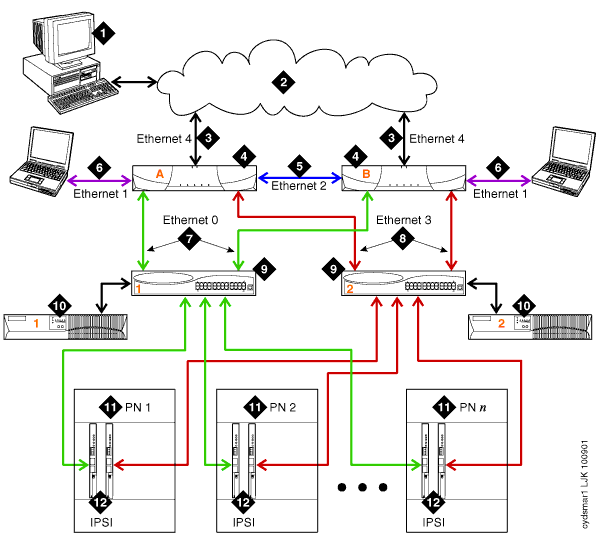
Items 1 through 7 are identical for duplex and high- or critical-reliability
configurations.
- Administration PC.
The administrator typically accesses the S8700 servers over the corporate
LAN.
- Corporate LAN.
The topology for the local area network varies significantly.
- Corporate LAN interface: default Ethernet 4. The server's Ethernet link to the
local area network, used for administration and (optionally) SNMP alarm
notification.
- Avaya S8700 Media Server.
Two are always present, one in active mode and the other on standby.
- Duplication interface: default Ethernet 2.
The dedicated, direct Ethernet connection between the two required
Avaya media servers.
- Services interface: default Ethernet 1.
The server's dedicated Ethernet connection to a laptop.
- Network control A interface: default Ethernet 0. The server's Ethernet connection
to 1 or 2 Ethernet switches. This private LAN carries the control signals
for the S8700 port networks when possible. Control network A is considered
the primary control network because it connects to the primary IPSI board
in a port network.
- Network control B interface: default Ethernet 3. The server's Ethernet connection
to a duplicated set of 1 or 2 Ethernet switches. This private LAN carries
the control signals for the port networks when the primary control network
is not available (for example, due to a hardware failure). Control network
B connects to the secondary IPSI board in a port network.
- Ethernet switch. At least one is required to support
each control network.
- UPS. An uninterruptible
power supply keeps each S8700 server and its set of Ethernet switches
functional through brief power outages. Typically UPS 1 powers server
A and its Ethernet switches, and UPS 2 powers server B and its Ethernet
switches.
- Port network (PN). Provides the telecommunications functions
of the S8700 system. The port network configuration is identical to the
duplex configuration, except that:
- Each IPSI-connected port network contains a pair
of IPSI boards, one primary board and a duplicate secondary board as a
backup.
- For a critical-reliability configuration, the
bearer network among the port networks is also duplicated. This means
that two EI
boards or two ATM boards are present in each port network instead of just
one.
- IPSI. The
Internet Protocol Server Interface (IPSI) circuit pack is duplicated in
every IPSI-connected port network in a high- or critical-reliability configuration.
The primary IPSI is
connected to control network A. It is the preferred IPSI because it has
better control over activating the clock than the secondary IPSI.
The secondary IPSI
is connected to control network B. This IPSI takes over in case of problems
with the primary control network. The server regularly tests the duplicated
IPSI to make sure it is ready for service, before returning control to
the primary IPSI.