LAN assessment
A Local Area Network assessment determines whether the current network infrastructure and bandwidth will support G700 Media Gateway telephony with adequate voice quality or whether network upgrades are necessary. A LAN assessment gathers information in a number of categories described below.
Network topology
In most cases, LAN infrastructure follows the standard distribution and core configuration. In smaller network environments, standard layers may be collapsed. A complete network topology map indicates the layers, devices, media, and port speeds, as well as servers, firewalls, and gateways.
Figure 4. Sample LAN Topology Map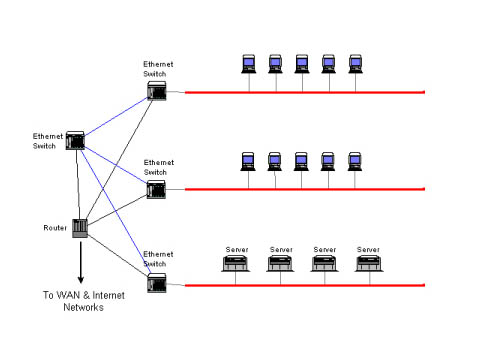
Figure 5. Sample LAN Topology Map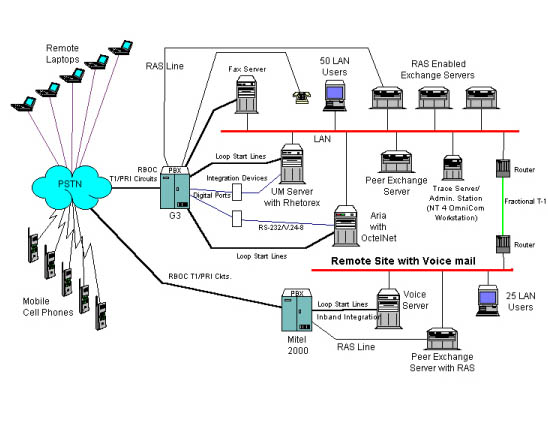
LAN infrastructure requires assessment in terms of the following:
- Network availability
- Network scalability
- Available average bandwidth
- Available peak or burst bandwidth
- QoS implementations
- Desktop/phone QoS
- Layer 2 and 3 convergence
Servers and existing gateways
LAN assessment identifies and locates all TFTP servers, DNS servers, DHCP servers, NAT gateways, firewalls, and existing gateways within the network, including any existing communication control servers. Server assessment includes level of availability, scalability, and available bandwidth.
Network devices
An inventory of network devices by type, number deployed, software installed, and services supported can help identify potential bottlenecks in VoIP data flow. Such an inventory identifies switched and shared media, bandwidth usage, users per link, and devices per subnet.
Baseline performance
Baseline network performance measurements include the following:
- Device average and peak CPU utilization
- Device average and peak memory utilization
- Peak backplane utilization
- Average link utilization (prefer peak hour average for capacity planning)
- Peak link utilization (prefer five minute average or smaller interval)
- Peak queue depth
- Buffer failure rates
- Average and peak voice call response times
Addressing plan
LAN assessment includes a review of the IP addressing plan and takes into consideration core routes and subnets, route and DHCP server plans, as well as any DNS conventions in effect. The IP addressing plan review should check for duplicate IP addressing and for subnet overlap. The addressing plan must be adequate to include the new addressing required when G700 Media Gateways are introduced.
Protocol implementation
LAN assessment catalogues the current network protocols to determine whether they match or can coexist with the protocols supported by G700 Media Gateways. Protocol analysis covers IP routing protocols, summarization methods, and routing protocol safeguards. It also takes into account HSRP configuration, VTP and VLAN configuration, and IPX, DLSW, or other required protocol services.
LAN assessment form
Table 22 shows a sample LAN assessment form.
Table 22. LAN Assessment�
| LAN Location |
|
|
| File Servers
File and print, database or application, intranet servers
|
|
|
| Terminal services
Windows Terminal server or X
|
|
|
| Internet servers
DNS, TFTP, and Firewalls. PORT Filtering or NAT in use. Web, dynamic application and database servers.
|
|
|
| Intranet servers
DNS, TFTP, and Firewalls. Web, dynamic application and database servers.
|
|
|
| Extranet services
Detail any services offered via extranet and usage patterns.
|
|
|
| Ethernet/Gigabit Ethernet/FDDI/Token Ring hubs and switches
Show segments and head counts per segment.
|
|
|
| Intermediate distribution facilities/wiring closets
List distances for Category 3 or 5 wiring.
|
|
|
| Segmenting via routers or switches
Layer 2, layer 3, and/or VLAN. If layer 3 and/or VLAN used, attach map showing logical topology
|
|
|
| LAN printers and fax systems |
|
|
| Routed protocols per segment
|
|
|
| Multicast enabled on network devices
Indicate if multicast is in use. Multicast mode in use. Purpose and scope of deployment.
|
|
|
| Routing protocols per segment
|
|
|
| Spanning Tree
Indicate if Spanning Tree is in use.
|
|
|
| Internet access for workstations
Indicate number of users per segment with internet access, PORT filtering in use (if any), NAT or PAT in use.
|
|
|
| Network operating systems on LAN
UNIX, LINUX, NT4, W2000, W2000 Server, W2000 Advanced Server, OS/2, NetWare, etc.
|
|
|
| Operating systems on LAN and desktops
UNIX, LINUX, NT4, W2000 Pro, W2000 Server, OS/2, NetWare, Windows 95, Windows 98, Windows Millennium, Windows 3.1a, WFWG, etc.
|
|
|
| Network Neighborhood Browsing
Indicate whether machines are configured to make broadcasts to LAN manager 2.x clients and whether the Microsoft browsing service is enabled on server and/or client machines.
|
|
|
| DHCP, DNS, WINS Servers
List IP addresses of servers and DHCP/WINS configurations.
|
|
|
| Network Domain Structures
Define and diagram DNS name space. If NT is used, show domains and trusts.
|
|
|
| IP addressing scheme
Includes all subnets, supernets and masks.
|
|
|
| Network management utilities in use
Sniffers, SNMP/RMON/SMON based, etc. If any are in use, include recent performance data collected for the network. The data should include net available bandwidths, data loss rates, latency, and if possible jitter for each LAN and WAN segment.
|
|
|
| SNMP
Indicate if SNMP is in use, whether enabled on all network devices, and the community names.
|
|
|
| QoS methods in use
802.1P, Diffserve, CoS Queuing, MPLS
|
|
|
| Video conferencing equipment
List manufacturer and model of any video conferencing equipment in use on the LAN.
|
|
|
| Policy servers
List any policy servers in use.
|
|
|
|

|

|