

|
|
|
A WAN infrastructure analysis is necessary when G700 Media Gateways are located within remote or branch offices linked to one another or to a central office by a Wide Area Network. A WAN assessment gathers information in a number of categories described below.
WAN infrastructure usually follows one of the following: the hub-and-spoke model; the meshed multi-site model; or a combination of the two. A network topology map indicates the WAN devices, remote LAN devices, DNS and DHCP servers, firewalls, and gateways. It also shows network interfaces and available bandwidth.
A WAN topology map makes it possible to assess network availability, topology issues that may impact voice quality, potential for expansion, and possible bandwidth limitations.
Figure 6. Sample WAN Topology Map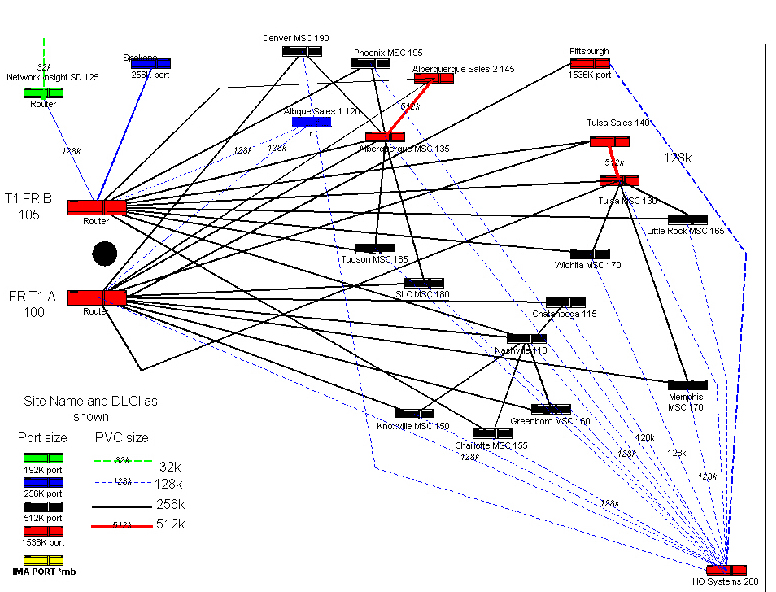
Figure 7. Sample WAN Topology Map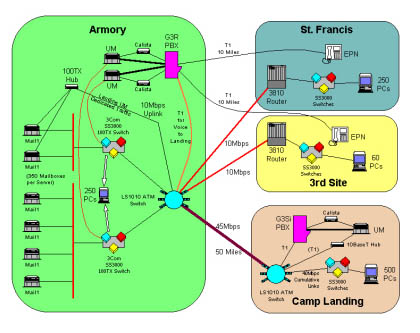
WAN assessment identifies and locates all TFTP servers, DNS servers, DHCP servers, NAT gateways, firewalls, and existing gateways within the network, including any existing communication control servers. Server assessment includes scalability and available bandwidth, existing gateway support for telephony, and potential impact of WAN connection loss.
An inventory of network devices identifies the WAN and remote LAN devices, the number of each, the software implemented, the services configured, WAN and LAN media (switched and shares), and bandwidth. It also determines the degree of redundancy within the network.
Use generally-accepted cabling standards appropriate to the environment and the technology.
Baseline network performance measurements include the following:
An assessment of WAN protocols includes the specific WAN IP protocol implementation and protocol overhead (including IPX and SNA protocol overhead), and Carrier Service subscription rates (port speed, CIR, expected performance). For VoIP data flow, carrier reliability and network quality are crucial factors.
WAN assessment details existing WAN QoS requirements to determine if they are adequate for VoIP data transmission and compatible with the voice QoS required by G700 Media Gateways.
Table 23 shows a sample WAN assessment form.
|
|
|