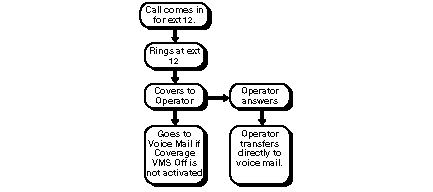
If eight or fewer extensions require coverage to the system operator, use delayed Primary Coverage or Secondary Coverage to allow calls to be covered by the operator. When a caller dials the user's number, the call is covered by the operator, and the operator can then send the call to voice mail using the Direct Voice Mail feature. If the operator does not answer, the call may or may not go to coverage, depending on the status of the user's Coverage VMS Off button. If the Coverage VMS Off button is not selected (the light is off), the call goes to voice mail. If the Coverage VMS Off button is selected (the light is on), the call continues to ring at the extension.
To set up Primary Coverage to the operator before going to voice mail, do the following:
Primary Coverage
For example, consider how the primary coverage configuration works when a
caller dials a DID number. The extension for the DID number (in the above figure,
Primary Coverage, Extension 12) rings several times. If the telephone is not
answered, an operator gets the call. If the operator fails to answer, the call
either goes to voice mail or keeps ringing, depending on the Coverage VMS Off
status on the extension for the DID number. When the operator answers and the
caller asks to leave a message, the operator uses Direct Voice Mail to transfer
the caller to the extension's voice mail. The caller leaves a message, and the
extension's message LED goes on.

