Coverage Feature
Description
Interaction of Individual and Group Coverage
Group Coverage can be used alone or with Primary and/or Secondary Individual
Coverage. When both Individual Coverage and Group Coverage are used, the
interactions between them follow this principle: If possible, a caller
should always get personal attention from someone with a Cover button
for the sender--going first to an Individual Coverage receiver, then to
a multiline telephone with a Group Cover button. In these cases, the receiver
can answer with either the name of the individual or the name of the group
being covered. Only when these types of receivers are unavailable or not
programmed does the call go to another, more impersonal type of Group
Coverage--either the QCC queue or a Calling Group (including a voice messaging
system Calling Group).
A call to a sender that is also ringing on Primary Cover, Secondary
Cover, and/or Group Cover buttons rings until answered (or the caller
hangs up). When the call is answered, the ringing and flashing green LED
are removed from all other telephones providing coverage for the sender.
When a Calling Group is programmed as the receiver for a coverage group,
however, the ringing and flashing green LED are removed from the sender's
telephone as the call leaves the Calling Group queue and is sent to an
available Calling Group member. (A call on a Personal Line button on the
sender's telephone is an exception. The ringing and flashing green LED
remain on that button until answered, either by the sender or by a receiver.)
 |
The duration of the ringback heard by an outside caller is shorter than
the actual ring heard at a 4400-Series, MLX, ETR, or MLS telephone. An
outside caller, therefore, hears one or two rings and may also hear the
number of rings programmed for the Coverage Delay Interval plus the number
of rings programmed for the Delay Ring Interval. For example, if the Coverage
Delay Interval is programmed for one ring and the Delay Ring interval
is programmed for two rings, an outside caller hears four rings before
the call begins ringing at receivers' telephones. If both intervals are
set to their maximum values, the caller can hear up to two additional
rings.
|
A call goes to Group Coverage depending on the following conditions:
- Whether the sender is available or unavailable.
- Whether the sender has Individual Coverage (Primary Cover or Secondary
Cover buttons programmed on other extensions) and, if so, whether an Individual
Coverage receiver is available.
- The type of Group Coverage receivers programmed:
- Only Group Cover buttons on multiline telephones
- Both Group Cover buttons and the QCC queue
- Only the QCC queue
- Only a Calling Group
- The Group Coverage Ring Delay is set for each sender's extension. When
Group Coverage is used in conjunction with Individual Coverage, calls should
ring at receivers for Individual Coverage first. Consider the following factors
before setting the Group Coverage Ring Delay for an extension:
- If a sender has only Primary Coverage and any receiver's Primary Cover
buttons are set to Delay Ring, the value for the Group Coverage Ring Delay
should be higher than the Primary Cover Ring Delay value for each sender.
- If a sender has both Primary and Secondary Coverage and all the receivers'
Cover buttons are set for Immediate Ring, the Group Coverage Ring Delay
should be to the number of rings the receiver wants to hear plus two rings
before the call is sent to group coverage
- If both Primary and Secondary Cover buttons are programmed for a sender
and any receiver's Primary and/or Secondary Cover buttons are programmed
for Delay Ring, the value should be set for the number of rings to be
heard at the Secondary Cover button before going to Group Coverage.
- Primary Cover Ring Delay
A sender is considered unavailable (his or her telephone does not ring) under
the following conditions:
- The sender has turned on Do Not Disturb. (In this case, the receiver can
call the sender.)
- All SA or ICOM buttons are in use on the sender's telephone.
- The sender is using extension programming or testing the telephone.
- The sender has a 4412D+, 4424D+, 4424LD+, or MLX display telephone and
is using the Alarm Clock or Directory feature.
- The sender's telephone is forced idle for system programming or centralized
telephone programming.
- The sender's telephone is not responding (for example, it is not connected).
- The sender has activated Remote Call Forwarding.
A receiver is considered unavailable (his or her telephone does not
ring) under the following conditions:
- The receiver has turned on Do Not Disturb. (In this case, the sender can
call the receiver.)
- Another call is ringing or answered on the receiver's Cover button for
that sender.
- The receiver is in extension programming or is testing the telephone.
- The receiver with a 4412D+, 4424D+, 4424LD+, or MLX display telephone is
using the Alarm Clock or Directory feature.
- The receiver's telephone is forced idle for system programming or centralized
telephone programming.
- The receiver's telephone is not responding (for example, it is not connected).
If a call is sent to Group Coverage and no receiver is available, the system
continues trying to send the call every five seconds until a Group Coverage
receiver becomes available. This repeated attempt to send the call is called
retry timing. The 5-second retry timing interval cannot be changed.
| |
Calls arriving at one system cannot be covered by extensions or Calling
Groups on a remote system (Hybrid/PBX mode only).
|
The Group Coverage Call Delivery Rules Table shows
when a call goes to Group Coverage receivers. The rules for sending calls to
Group Coverage apply after the calls first go to any available Individual Coverage
receivers (as described in See Ringing on Individual
Coverage table.
See the Individual (Primary and Secondary) and Group
Coverage Ringing Patterns for examples of LED and ringing patterns. See
Group Coverage Only or All Individual Coverage Receivers
for what happens when both individual coverage (Primary and Secondary) and Group
Coverage are programmed for an individual sender.
Group Coverage Call Delivery Rules
|
Receiver Type
|
Sender Status
|
Primary Coverage Receiver Status
|
Secondary Coverage Receiver Status
|
Sent to Group Coverage after
|
|
Group Cover button(s) only, or Group Cover button(s) and QCC queue
|
Available
|
Available
|
Available
|
GCD + PRD
|
|
Unavailable or
unassigned
|
GCD + PRD
|
|
Unavailable or
unassigned
|
Available
|
GCD + PRD
|
|
Unavailable or
unassigned
|
Immediate
|
|
Unavailable
|
Available
|
Available
|
GCD + PRD
|
|
Unavailable or
unassigned
|
GCD + PRD
|
|
Unavailable or
unassigned
|
Available
|
GCD + PRD
|
|
Unavailable or
unassigned
|
Immediate
|
|
QCC Queue only
|
Available
|
Available
|
Available
|
GCD + PRD
|
|
Unavailable or
unassigned
|
GCD + PRD
|
|
Unavailable or
unassigned
|
Available
|
GCD + PRD
|
|
Unavailable or
unassigned
|
GCD
|
|
Unavailable
|
Available
|
Available
|
GCD + PRD
|
|
Unavailable or unassigned
|
GCD + PRD
|
|
Unavailable or
unassigned
|
Available
|
GCD + PRD
|
|
Unavailable or
unassigned
|
Immediate
|
|
Calling Group only
|
Available
|
Available
|
Available
|
GCD + PRD
|
|
Unavailable or
unassigned
|
GCD + PRD
|
|
Unavailable or
unassigned
|
Available
|
GCD + PRD
|
|
Unavailable or
unassigned
|
GCD
|
|
Unavailable
|
Available
|
Available
|
GCD + PRD
|
|
Unavailable or
unassigned
|
GCD + PRD
|
|
Unavailable or
unassigned
|
Available
|
GCD + PRD
|
|
Unavailable or
unassigned
|
Immediate
|
Where:
GCD = Group Coverage Ring Delay
PRD = Primary Cover Ring Delay
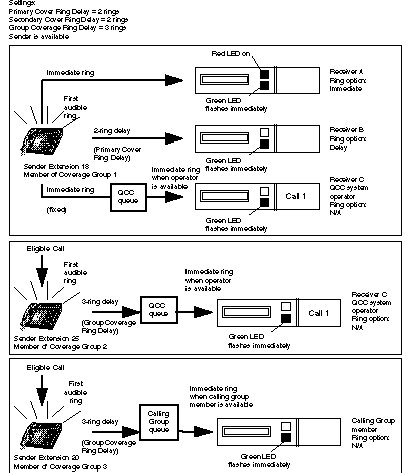
Group Coverage Only or All Individual Coverage Receivers Unavailable
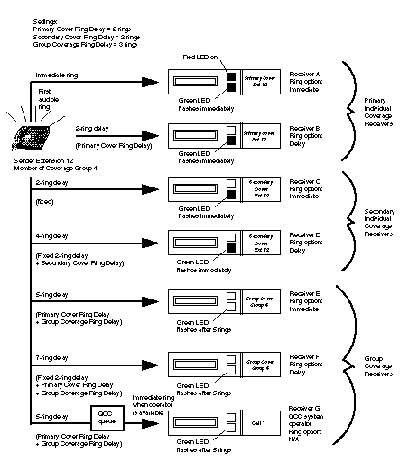
Individual (Primary and Secondary) and Group Coverage Ringing
Patterns

